About this activity
- Duration
- 1 hour
- Areas Visited
- Shinjuku
- Languages
- Japanese, English
- Group size
- 1–8 participants
- Confirmation
- Instant Confirmation
- Free Cancellation
- Cancel up to 24 hours before the activity for a full refund.
Accessibility and additional details
- Required Fitness Level
- Moderate — Some walking required
- Wheelchair Accessible
- Yes
- Stroller Accessible
- Yes
Highlights
- Explore three contrasting garden styles inside Shinjuku Gyoen with admission included
- See red maples, golden ginkgo and autumn sycamores across different landscapes
- Learn how the former feudal estate became an imperial garden and later a public national garden
- Discover how Japanese strolling-garden design differs from formal and landscape gardens
- Enjoy casual photo support and continue exploring independently after the one-hour tour
Description
Discover how autumn looks completely different across three landscapes inside one of Tokyo’s most famous gardens.
This one-hour guided walk through Shinjuku Gyoen National Garden combines seasonal color with garden design and history.
Rather than simply searching for the brightest leaves, compare a spacious landscape garden, a symmetrical formal garden, and a traditional Japanese strolling garden while learning how Shinjuku Gyoen developed from a feudal estate into an imperial garden and later a national garden open to the public.
Admission is included.
Begin at Shinjuku Gate
Meet your guide outside Shinjuku Gate and enter the garden together.
Shinjuku Gyoen’s history reaches back to land granted to the Naito family in 1590.
After the Meiji Restoration, the grounds became an agricultural experimental station and later an imperial botanical garden. A major redesign completed in 1906 created the basis of the garden seen today, and Shinjuku Gyoen opened to the general public as a national garden in 1949.
See autumn in the Landscape Garden
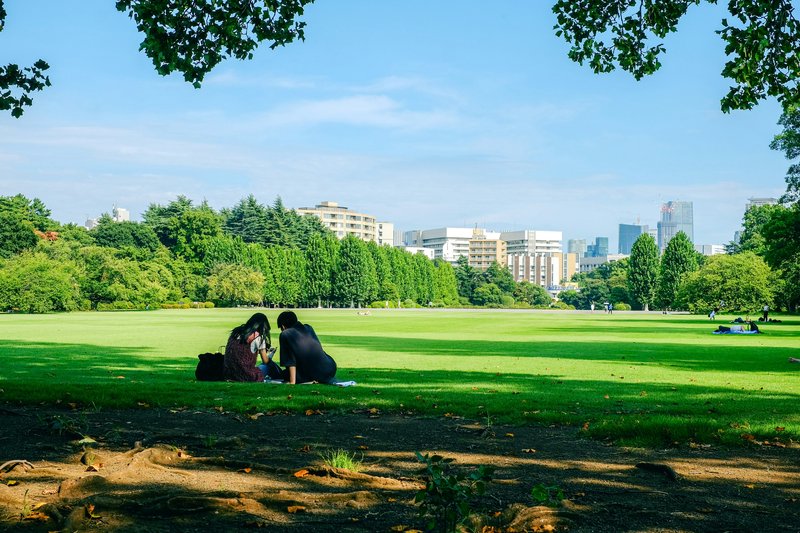
Enter a broad landscape of lawns and large trees.
The Landscape Garden was designed around long views and open space rather than geometric planting.
Its Main Vista forms one of the defining views of Shinjuku Gyoen, while ginkgo trees turn brilliant yellow in autumn.
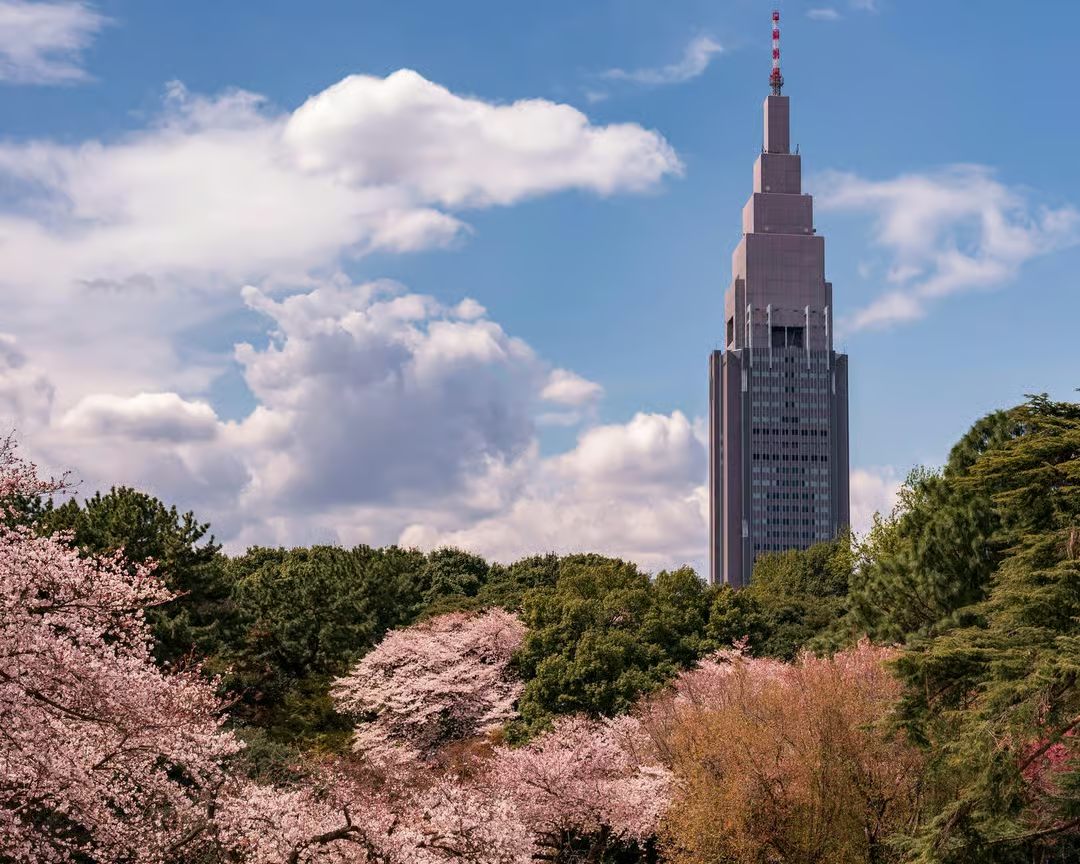
This open scenery also creates one of the garden’s most distinctive Tokyo contrasts: seasonal trees and lawns framed by the city skyline.
Compare it with the Formal Garden
Move toward the Formal Garden and notice how dramatically the design changes.
Here, symmetry and geometry replace the loose natural appearance of the Landscape Garden.
Around 160 sycamore trees are planted in eight straight rows along the garden, and their leaves turn golden as autumn progresses.
Your guide will explain why this formal European-style space feels so different even though it is only a short walk from the surrounding lawns.
Enter the Japanese Traditional Garden
Continue into the Japanese Traditional Garden.
This area follows a strolling-garden layout around the Upper Pond and uses water, bridges, trees, shrubs, and changing viewpoints to create a different experience from the two Western-influenced landscapes.
In autumn, Japanese maples around the garden turn shades of red, orange, and pink.
Rather than seeing the whole landscape at once, notice how views appear and disappear as you walk.
Discover the garden’s imperial history
The current garden layout was created during a period when the grounds belonged to the Imperial Household.
French landscape architect Henri Martinet prepared a new design at the request of Fukuba Hayato, and large-scale renovation between 1902 and 1906 created the basis of the present garden.
The result is unusual in Tokyo: Japanese garden traditions and European landscape design coexist within one historic space.
See Kyu-Goryo-Tei from the garden
Depending on the route and time, see the distinctive Kyu-Goryo-Tei pavilion beside the Japanese garden.
The pavilion was completed in 1927 and presented to the imperial family by Japanese residents of Taiwan to commemorate the wedding of Crown Prince Hirohito, later Emperor Showa.
Its waterside setting is particularly photogenic when surrounding trees are changing color.
Enjoy different autumn colors
Shinjuku Gyoen is not a single-color autumn destination.
Depending on timing, you may see:
Red and orange Japanese maples
Yellow ginkgo trees
Golden sycamores
Seasonal reflections around the ponds
Fallen leaves across lawns and paths
Tokyo’s official tourism information describes Shinjuku Gyoen as one of the city’s notable places for autumn colors.
Autumn color is never guaranteed
Foliage changes naturally according to temperature, wind, rain, and the timing of your visit.
Some areas of the garden may still be green while others have already reached peak color or begun to lose their leaves.
Your guide will adjust the route within the available hour to focus on the most interesting seasonal areas that day.
Take casual photos
Your guide can help take casual photographs using your own smartphone or camera.
Possible backgrounds include red maples, yellow ginkgo trees, the sycamore avenue, ponds, bridges, and open lawns.
This is not a professional photography session.
Commercial photography and videography inside Shinjuku Gyoen are restricted, so this tour offers only normal personal-photo assistance rather than a commercial photoshoot.
Continue exploring afterward
The guided portion lasts approximately one hour.
Because your admission is already included, you may continue enjoying the garden independently after the tour, subject to the garden’s closing time.
Ask your guide which areas are worth revisiting based on that day’s foliage.
Included
What's Included
- English- or Japanese-speaking local guide
- Shinjuku Gyoen National Garden admission ticket
- Introduction to Shinjuku Gyoen’s history
- Explanation of Japanese and European-inspired garden design
- Casual photography assistance using your own phone or camera
What's Not Included
- Professional photography
- Food and drinks
- Hotel pickup and drop-off
- Personal expenses
- Gratuities
Meeting Point
Enter a Garden Shaped by Centuries of Change
Shinjuku City, Tokyo, Japan
Meet at Shinjuku Gate, enter with your included ticket, and learn how the grounds evolved from a Naito family estate to an imperial garden and eventually a national garden open to the public.
Itinerary
- Visit 15min
See Golden Ginkgo Across Open Lawns
Walk through the broad Landscape Garden and discover its long vistas, giant trees, open lawns, and seasonal ginkgo color.
- Visit 10min
Walk Beneath the Golden Sycamores
Compare the natural landscape with the symmetry of the Formal Garden and its rows of approximately 160 sycamore trees.
- Visit 20min
Discover Maples, Ponds and Changing Views
Walk beside the Upper Pond through the Japanese strolling garden and look for seasonal red and orange maple foliage, bridges, and waterside scenery.
- Visit 5min
Choose Where to Explore Next
Finish with seasonal photos when conditions allow and get recommendations for continuing through Shinjuku Gyoen independently.
Important Information
- Admission to Shinjuku Gyoen National Garden is included.
- Garden operating hours, closure days, and temporary restrictions may change, so current official information takes priority.
- Autumn foliage is a natural phenomenon and peak colors cannot be guaranteed.
- Depending on your date, some trees may be green, partly colored, at peak, falling, or already bare.
- The exact walking route may change according to foliage, crowds, weather, maintenance, or temporary restrictions.
- Alcohol is prohibited inside Shinjuku Gyoen.
- After the guided portion, guests may remain in the garden independently until closing time.
Pricing
Prices by participant and group size
| Participant | All group sizes |
|---|---|
| Adults (Ages 13-99) | ¥5,500 |
| Children (Ages 2-12) | ¥4,500 |
| Infants (Ages 0-1) | ¥0 |
Price is charged per participant. The total is calculated by multiplying the unit price by the number of participants.
Free Cancellation
Cancel up to 24 hours before the activity for a full refund.
Cancellation Timeline
Reviews
Questions & Answers
No questions yet. Be the first to ask!